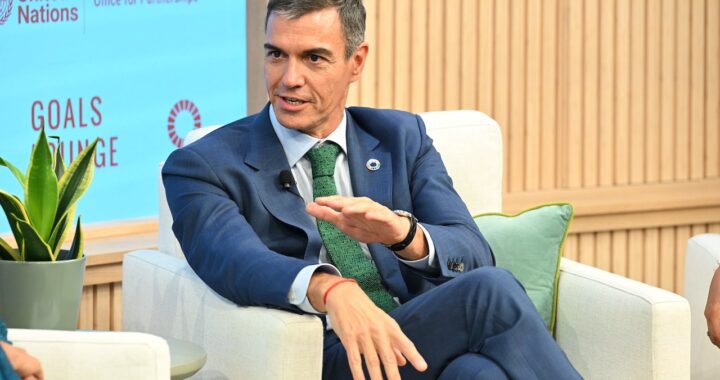

Prime Minister unveils visual maritime border solution following Supreme Court ruling that blocked immediate returns.
Prime Minister Pedro Sánchez announced on Friday the installation of “buoys along the breakwater” at Ceuta’s border to visually demarcate the maritime boundary with Morocco, enabling the immediate return of those who enter irregularly. The measure is the Government’s response to a recent Supreme Court ruling that prohibited express repatriations of individuals intercepted at sea, on the grounds that unlike land border crossings, there is no clearly identifiable physical boundary line.
Von der Leyen Demands Fast Returns as Ceuta Migrant Crisis Nears Breaking Point
Sánchez described the events in Ceuta as a “violation of Spain’s territorial integrity,” though he stopped short of directly blaming Morocco, attributing the crisis instead to human trafficking networks that he accused of exploiting the judicial ruling to encourage crossings via the breakwater. Following a coordination meeting with Ceuta authorities, Sánchez explained that installing the buoys would visibly mark the point at which a person is considered to have entered Spanish territory. The Government’s aim is that individuals intercepted before crossing that demarcation can be handed over immediately to Morocco, thereby circumventing the legal vacuum created, according to the Supreme Court, by the absence of a clearly identifiable physical border at sea.
The announcement comes after nearly 50,000 people have massively crossed the border in recent days, in a crisis that has already claimed dozens of lives and represents the most intense migratory pressure recorded on the Moroccan border this century. Sánchez condemned “in the strongest and most forceful terms” what he defined as a “violation of Spain’s territorial integrity,” though he avoided holding Rabat directly responsible and instead underscored the cooperation between the two countries.
Like Morocco, the Prime Minister insisted that the events stem from a “self-serving interpretation” of the Supreme Court ruling, which he said spread “like wildfire” through human trafficking networks, triggering “an avalanche.” While he alluded to the 2021 migration crisis triggered by Spain’s hosting of Polisario Front leader Brahim Ghali, he avoided drawing political parallels between the two episodes, stressing instead that the recent entries “break the trend” of sustained reduction in migratory flows, which fell by around 36% last year. Sánchez therefore reaffirmed the value of cooperation with Morocco to “fight, as we have been doing,” against the mafias trafficking in human beings. He also thanked the Moroccan authorities for their willingness and expressed confidence that the commitment to expedite repatriations would materialise “as soon as possible.”
🇪🇸🇲🇦 | Sánchez anuncia en Ceuta que se va a colocar una barrera física de boyas, y que antes de usar la fuerza se hará una campaña de información para intentar que los invasores se marchen de manera voluntaria. pic.twitter.com/d46eMqOwjk
— ʜᴇʀQʟᴇs (@herqles_es) July 31, 2026
As a “contingency” response, he proposed installing buoys along Ceuta’s border breakwater, a task the Government has entrusted to the state-owned maritime rescue company Salvamento Marítimo, in collaboration with the Navy and the Civil Guard. The aim is to establish this physical reference point so that individuals intercepted before crossing it can be handed over immediately to Morocco, while those who pass beyond it would be considered to be within Spain and subject to the procedures and guarantees established by immigration law.
Regarding those returning to Morocco after having entered Ceuta irregularly, Interior Ministry sources confirmed that by Friday morning repatriations had already reached 25,000, approximately half of the arrivals recorded so far. According to Government calculations, “voluntary” departures from the autonomous city are occurring at a rate of around 150 people per minute. Sánchez highlighted the speed of the process and noted that the asylum committee would meet on Friday to advance the “processing of pending files.” The aim is to review the individual situation of those who have applied for international protection and complete the necessary procedures to expedite the repatriation of those not entitled to remain in Spain.
Hundreds Of Migrants Cross Into Ceuta As Border Pressure Intensifies
Furthermore, Sánchez also left the door open to “modifying certain aspects of the laws” to make repatriations “as efficient as possible,” and pledged to “take charge” of the situation using “all the resources of the State” to “guarantee the security of Ceuta’s residents and coexistence in Ceuta.” “We have always deployed these resources. The commitment is resolute, total and unequivocal to the present and future of Ceuta,” he affirmed.